Buxton Heritage Trail
Buxton has a rich heritage from Stone Age settlers to Edwardian splendour. This trail, which can also be found in the Buxton Town Guide, leads you around the historic centre and beyond to the inspiring architecture, fantastic attractions and hidden gems which make Buxton what it is.
Locations are marked on the accompanying map via reference letters.
For more information about the history and heritage of the town, join Discover Buxton on a walking tour or visit the Buxton Crescent Experience.





Designed by John Carr, the Crescent (A) was built by the fifth Duke of Devonshire in the 1780s to provide accommodation for visitors attracted to the town by the health-giving waters. This Grade I-listed building has been restored to its former glory and reopened in 2020 as an 80-bedroom five-star hotel and spa. Some ground floor and basement rooms are open as part of the Buxton Crescent Experience.
The Natural Baths, to the left of the Crescent, on the site of the original Roman Bath, were built between 1851 and 1854. They too have been restored and form the centre piece of the health and wellness spa.
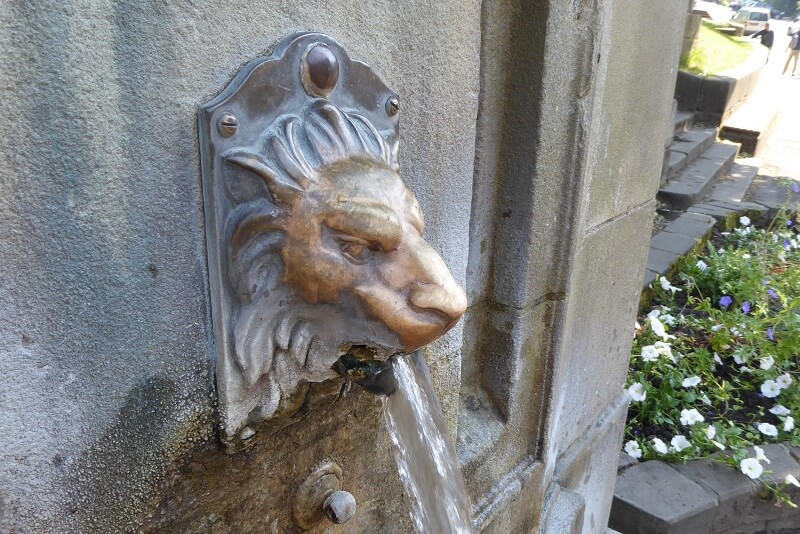
Presented to the town in 1940, the prominent St Ann’s Well is constantly fed with thermal spring water at a temperature of 27.5°C and stands next to the Pump Room.
The Pump Room was built in 1894 by Henry Currey as an addition to the ‘water treatments’ of the time. In use until 1981, it is now open as the Buxton Visitor Centre.
To the right of the Crescent is the Cavendish Arcade. Originally designed as hot baths in 1854, it now serves as a boutique shopping arcade. It features an original plunge bath and the interior still has most of its Minton tiling. The striking glass barrel vaulted ceiling by Brian Clarke was installed in the 1980s when it was transformed into the arcade.
By the Cavendish Arcade is Turner’s Memorial, erected in 1879 in memory of a local benefactor, Samuel Turner. It was restored and relocated in 1994 following damage due to a car crash.
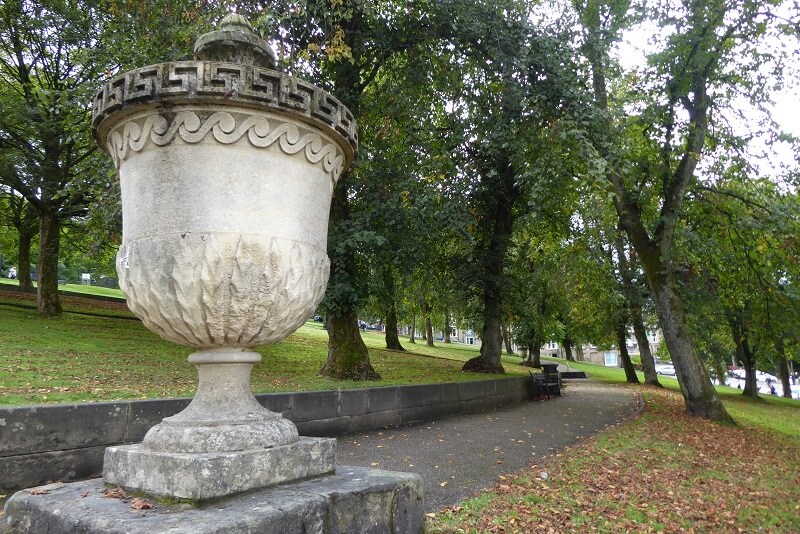
Head up The Slopes (C), rising in front of the Crescent. They were designed by Sir Jeffry Wyatville in 1818 and modified by Joseph Paxton in 1840. If you follow the paths through the trees you will notice that together with the Crescent they form a complete circle. In the centre is the town’s war memorial and climatological weather station – the third oldest weather site in the UK with unbroken records dating back to 1865!
At the top of The Slopes, stands the imposing Town Hall (D), designed by William Pollard in 1889.
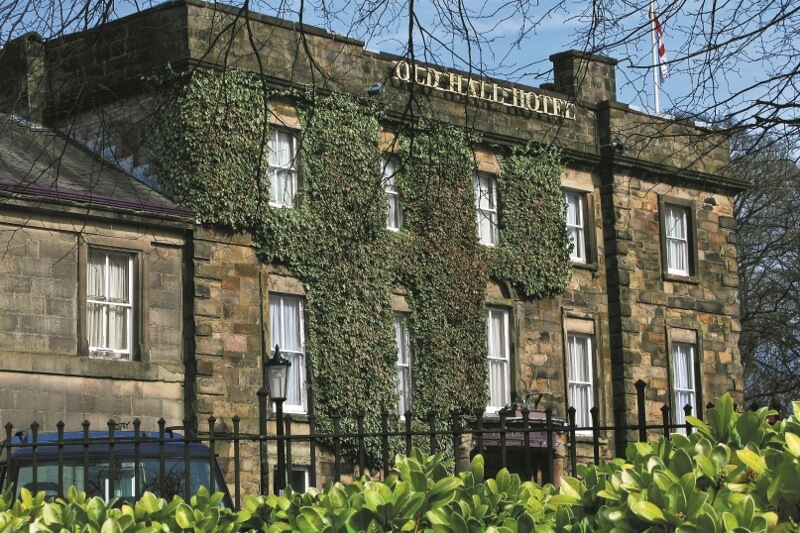
Head down the other side of the Slopes, taking in the wonderful views along Water Street, to the Old Hall Hotel (E), the oldest building in Lower Buxton. It was originally built by the 6th Earl of Shrewsbury and housed the captive Mary, Queen of Scots, who visited a number of times between 1573 and 1584 to take the waters.
Head along Water Street, past the colonnaded town houses of The Square, to the Buxton Opera House (F). Designed by Frank Matcham, it was opened in 1903 and restored in 1979. One of the finest provincial theatres, it presents a varied programme of music, drama, comedy and dance throughout the year.
Opposite Buxton Opera House, you will see an original ‘Penfold’ Victorian Post Box installed in 1867 and it is one of only a few original Penfolds still in use.
Head along George Street to The Old Court House (G). Built by the fifth Duke of Devonshire, it now houses a variety of restaurants and cafés and a masonic hall.
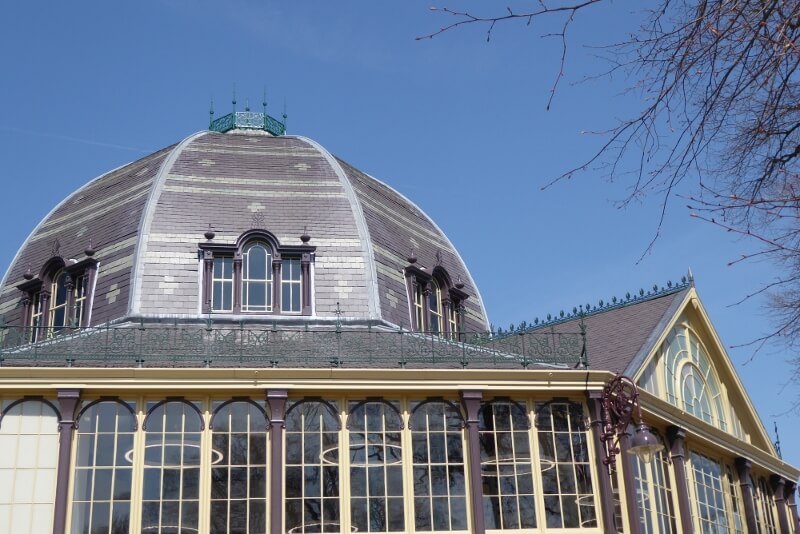
On your left, dominating the Buxton skyline, is the Devonshire Dome (H), home of Buxton & Leek College. The Dome, with a diameter of 46 metres, built by Robert Rippon Duke in 1880 for the Devonshire Hospital, sits on the original building by John Carr which housed the horses and servants of the guests of the Crescent hotels. The general public are welcome inside when not closed for private events. Call ahead to avoid disappointment. The southern extension houses the Devonshire Spa.
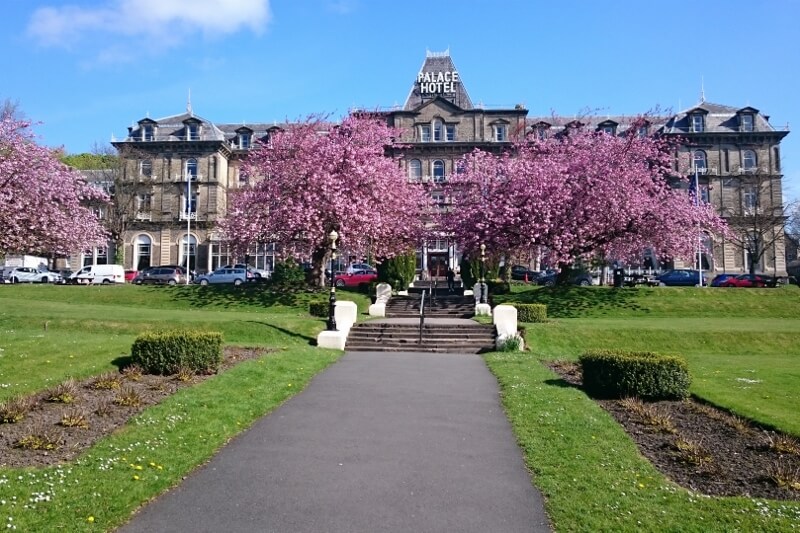
Next door to the Dome is the imposing Palace Hotel (I). Completed in 1868, it was one of a number of grand hotels built for the numerous spa visitors.
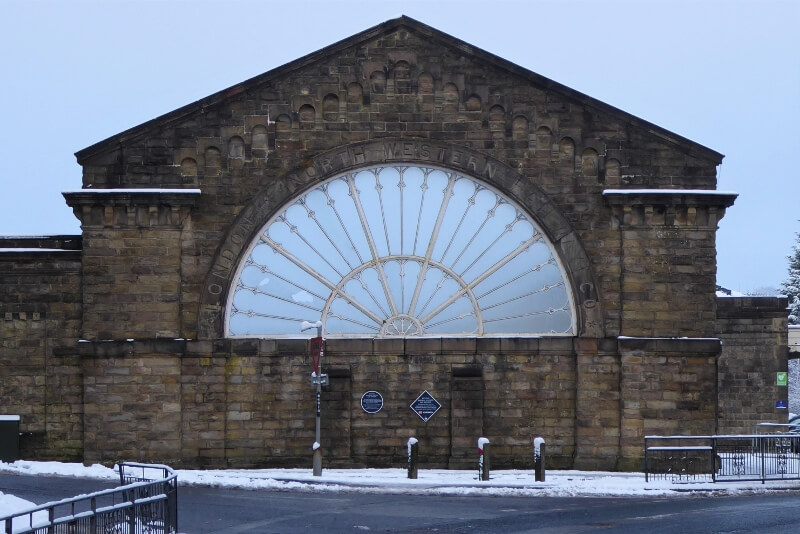
The great Fan Window (J), designed by Joseph Paxton is one of the two fan windows which stood at the end of the two railway stations, one of which is now demolished.
Cross the road and walk along the Quadrant. At the entrance to Spring Gardens, is The Children’s Well (K). Made of pink granite, it was presented to the town in 1886.

Wander along Spring Gardens, the town’s main shopping street. Keep an eye out on your left for the old Royal Hotel, with its grand, pillared entrance, and on your right for Victorian homeware shop and tearooms, Hargreaves of Buxton (L).
Half way along Spring Gardens is the Miltons Tap (M) which dates from the early 1800s and is one of the oldest buildings in the Spring Gardens area.
Make your way back to Terrace Road via Hardwick Street. On the corner, pop into Potters of Buxton (N), Victorian department store established in 1860.
Head up Terrace Road to Peak Buildings (O), originally host to the Peak Hydropathic Hotel. it was home to the Buxton Museum and Art Gallery between 1928 and 2023. Hardwick Hall, behind Peak Buildings, was an extension to the Peak Hydropathic Hotel with a Victorian sprung dance floor built in 1896. Between 2015 and 2024, it housed The Green Man Gallery which a varied programme of exhibitions, workshops, arts events and live music.
Cross over the road to the Market Place (P). At 1032 feet above sea level, it is officially the highest in England. Is ringed by some of the older buildings of the town which make up the Higher Buxton shopping area. It has an open market every Saturday and Tuesday. Here you will also find a variety of pubs, restaurants, wine bars and clubs.
The Market Cross, relocated in 1813 to mark the Royal Charter awarded to Buxton Market is situated on the Town Hall Piazza.
Walking along the Market Place, past the old well pump, you’ll see the Buxton Methodist Church, built in 1848.
Along the High Street you’ll find the Old Sun Inn (Q). Set back from the road, it reflects the original line of the Georgian High Street. Note the ‘Good Stabling’ sign harking back to its days as a coaching inn and stables.
A little further along, behind the Swan Inn, is St Anne’s Church (R), thought to be the oldest building in the town, just off Bath Road. (The porch is a later addition).
A walk along Green Lane from Fiveways, at the end of High Street, will take you to Poole’s Cavern (S), one of the seven Wonders of the Peak, which extends for over 300 metres into the limestone of the hillside above the town. Visited by prehistoric cave dwellers, Celtic and Roman visitors, medieval outlaws and Elizabethan royalty, it has a wealth of history and legend as well as spectacular stalactite formations. Conducted tours are available all year round.
Alternatively, head down Bath Road to Broad Walk (T), a fashionable terrace of houses designed by a variety of prominent architects from the 1860s to the 1880s, which overlooks the Pavilion Gardens.
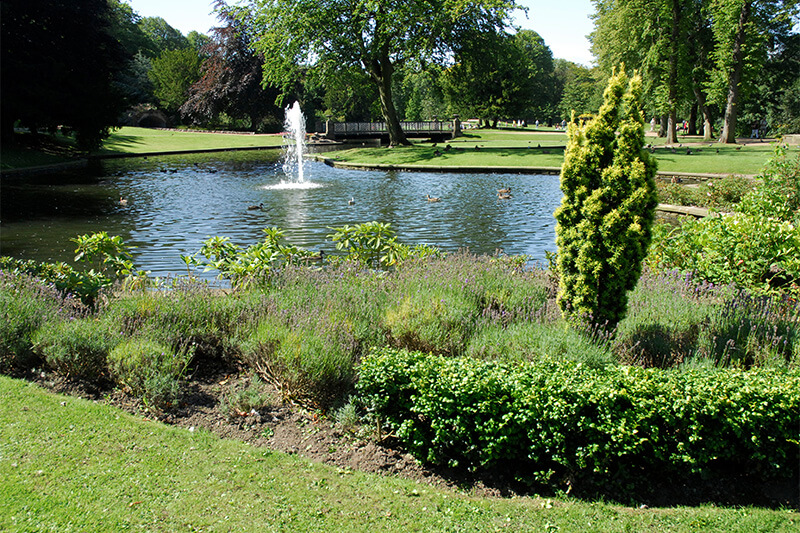
The Pavilion Gardens (U), designed by Edward Milner and opened in 1871 on 23 acres of land given by the 7th Duke of Devonshire, were restored to the original layout in 2000. Here, along the banks of the River Wye, are the imposing bandstand, the ‘Snail Back’ garden, miniature railway and lakes filled with a variety of water birds and the six-metre fountain.
The Octagon Hall was designed by Robert Rippon Duke and opened in 1876. Recently restored, it now houses a variety of fairs, auctions, concerts and events. Next door is the Swimming Pool & Fitness Centre.
The Pavilion Gardens Complex, originally the Winter Gardens, now houses a restaurant and bar, ice-cream parlour, conservatory, the Gallery in the Gardens and retail arcade. The Pavilion Arts Centre, re-opened as a flexible performance and conference venue in 2010, is home to Buxton Cinema.
Walk through the complex and cross over St John’s Road to St John’s Church (V), designed by John White & Son in 1811 in a neo-classical ‘Tuscan’ style.
The Victorian circular Devonshire Park estate (W), like other parts of Buxton, was laid out by Joseph Paxton. In the middle is the cricket ground, ringed by houses of varied architectural styles including a former residence of Vera Brittain and the Lee Wood Hotel. The cricket ground is famous for having a Derbyshire county match called off for snow in June!
From November 2025, this website is owned and managed by Buxton Civic Association Ltd - Charity No. 258163.

Buxton Civic Association celebrates the natural and human heritage of Buxton including its outstanding buildings and wildlife. We conserve and enhance this heritage and advocate its importance in making Buxton a special place to live or to visit.